
Terminology
Internally, ORBAT Mapper uses a data model that is related to the Military Scenario Definition Language (MSDL). This section gives the terminology that you find when you build a scenario.
Sides and groups
A scenario has units. The units are in sides and groups. Usually a side is a nation or a coalition. In a WWII scenario the sides are usually Allied forces and Axis forces.
For each side you can specify a standard identity (affiliation). The standard identity controls the color and the shape of the unit icons. Friend, neutral and hostile are the most usual identities:
Friend
Neutral
Hostile
You can also select custom colors. Custom colors are useful when you do not want to show a side as hostile. They are also useful when you want to identify different nations by the color of the symbol.
Each side has one or more groups of units. A group is only a method to organize your units. For example, a group can be a branch (army, navy, air force, etc.), a task force or a battlefront. You can also use no groups and put the units directly below a side.
A side or a group has one or more unit hierarchies. The unit at the top of a hierarchy is the root unit.
Units
A unit is the basic element of a scenario. Usually a unit is a military unit, for example a platoon, a company or a battalion. But a unit can also be infrastructure, equipment, a vehicle, etc.
The units are in a hierarchy with a tree structure:
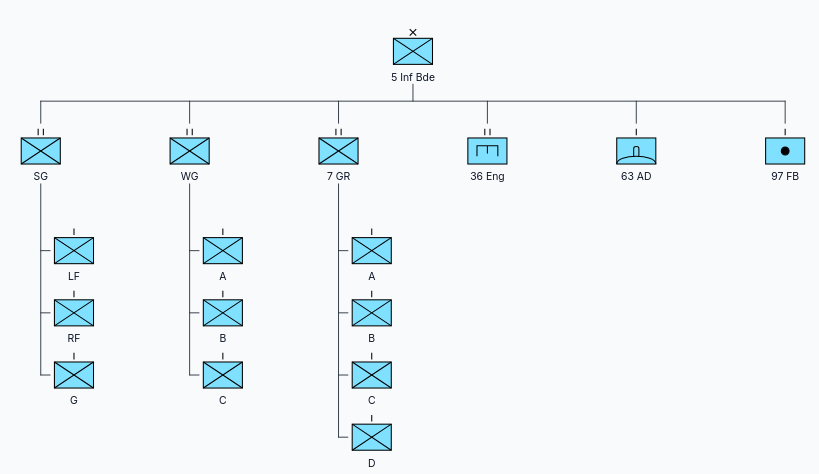
Each unit has a set of attributes. These attributes are the most usual:
- name
- symbol/icon
- location
You can give more attributes to a unit. These are examples:
- description
- image
- url
- symbol modifiers
- average speed
- maximum speed
Unit state
In ORBAT Mapper, the state of a unit is the set of current values of its attributes. These values can change in time. For example, the location of a unit changes as the unit moves. Its symbol can change if the unit becomes damaged or destroyed. ORBAT Mapper is not a simulation tool. But it can record the changes of some unit attributes as the scenario continues.
Table of Organization and Equipment (TO&E)
A military unit has personnel and equipment. Usually this composition is the Table of Organization and Equipment (TO&E). The TO&E gives the structure, the roles and the responsibilities of the personnel of the unit. It also gives the types and the quantities of the equipment.
ORBAT Mapper has basic support for TO&E data.
Map layers and features
The map is an important part of a scenario. A scenario map has more than one layer. The application draws the base layer first. On the base layer you can add raster map layers, and then feature layers.
A raster map layer has one or more raster images. Usually raster map sources are aerial photos and scanned maps. A feature layer has one or more features. A feature is a point, a line or a polygon with a style on the map.