
Import data
ORBAT Mapper can import units and features from these sources and formats:
- GeoJSON
- MilX
- Spatial Illusions ORBAT Builder
- Order of Battle Generator
- Decisive Action Training Environment (DATE) force structures
You can also import KML/KMZ files as temporary map layers. See Work with map background layers.
Start the import
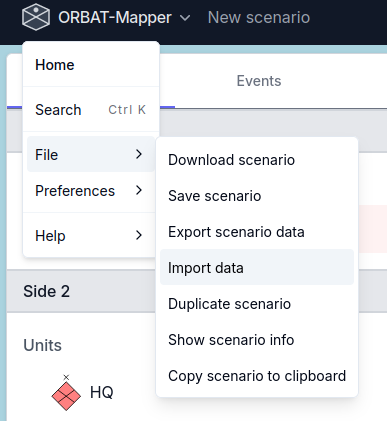
To start the import, select Import data from the File menu.
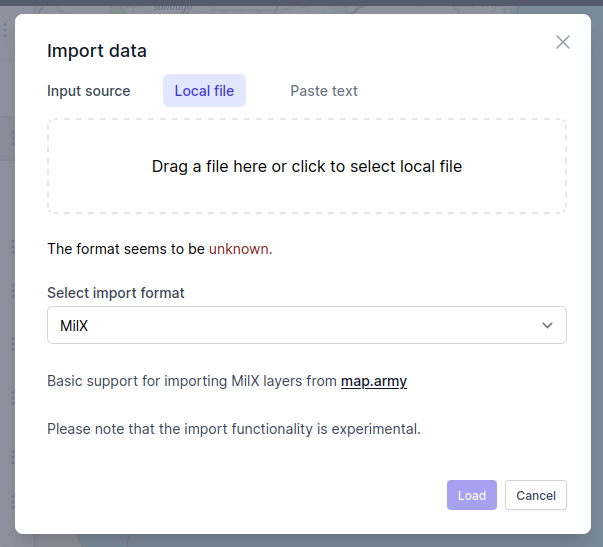
The Import data dialog opens. You see it below. As an alternative, drag a supported file and drop it on the map to start the import. Select the file for the import and click Load. Usually ORBAT Mapper finds the correct import format automatically. If it does not, select the correct format from the Select import format dropdown list.
GeoJSON
MilX
MilX (common military exchange format) is a format that uses XML. It exchanges military map overlays. For example, the excellent map.army tool uses it to keep map overlays. ORBAT Mapper can load overlays from map.army. It supports compressed (.milxlyz) and uncompressed (.milxly) files.
INFO
ORBAT Mapper supports only a small part of the MilX format. There can also be a compatibility problem, because map.army uses MILSTD 2525C/APP6-C symbol codes with letters. ORBAT Mapper tries to change them into 2525D/APP6-D codes, but this operation can fail for some symbols.
Spatial Illusions ORBAT Builder
Spatial Illusions ORBAT Builder is a tool that makes military symbols and ORBATs. The tool can export ORBATs in a simple JSON format. ORBAT Mapper supports this format.
Order of Battle Generator
Import data from Order of Battle Generator.
Decisive Action Training Environment (DATE) force structures
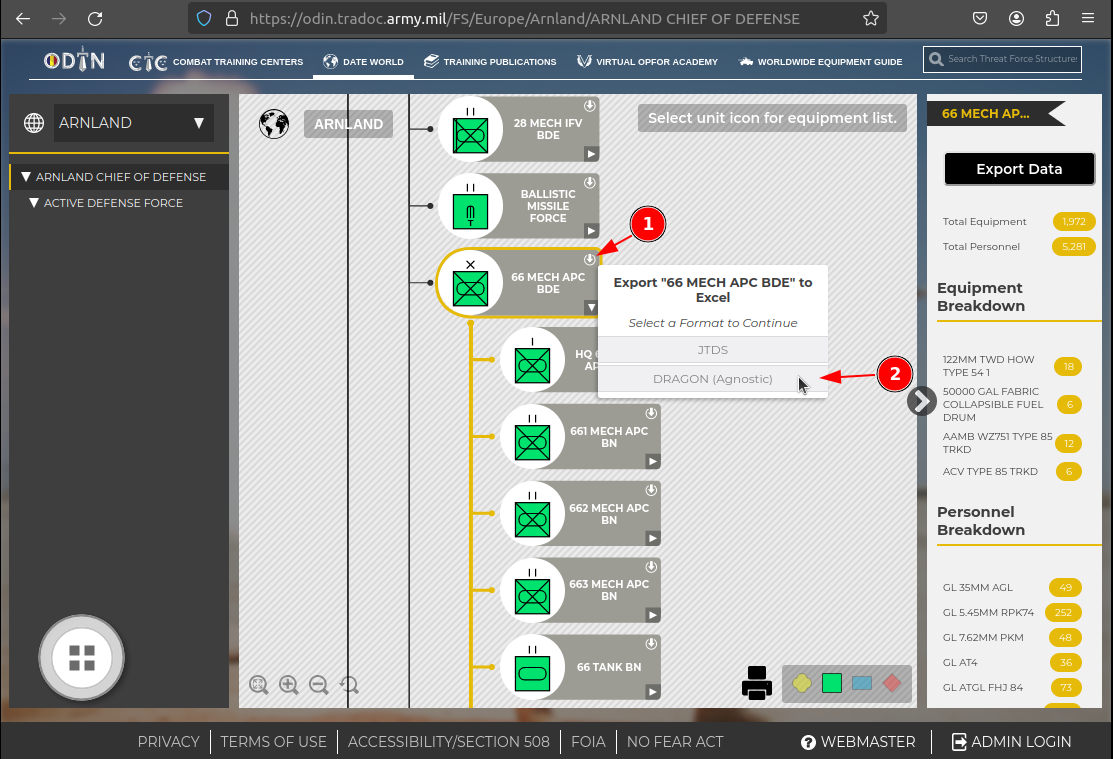
The Decisive Action Training Environment World is a training environment of the U.S. Army. To import a DATE World force structure, first download the force structure from the DATE World website. The screenshot below shows this operation. In the force structure viewer, each unit has a small export button in the top right corner. Click the export button and select the DRAGON (Agnostic) format. A .xlsx file downloads to your computer. It contains all the units, the equipment and the personnel of the force structure.
WARNING
The DATE World force structures are very large and can contain thousands of units. If you import a very large force structure, the performance of ORBAT Mapper decreases. Import smaller parts of the force structures.
When the .xlsx file is on your computer, open the Import data dialog to import it. As an alternative, drag the .xlsx file and drop it on the map. ORBAT Mapper identifies a DATE World force structure automatically.
Import options
- Parent unit. This option shows a list of the root units in the scenario. Remember that you can always move units after the import.
- Expand templates. DATE World force structures use templates to define the structure of the units. If you enable this option, ORBAT Mapper expands the templates and imports all the units of the force structure. If you disable it, ORBAT Mapper imports only the units at the top level.
- Include equipment. If you enable this option, ORBAT Mapper imports the equipment from the unit templates and puts it in the TO&E of the unit.
- Include personnel. If you enable this option, ORBAT Mapper imports the personnel from the unit templates and puts it in the TO&E of the unit.
Tabular data (Excel/CSV)
You can import units from Excel (.xlsx) or CSV files. Thus, you can use data from spreadsheets and other tools.
Column mapping
When you import a tabular file, a column mapping screen shows. On this screen, connect the columns of your file to the properties of the units.
Necessary fields:
- Name: The name of the unit. This field is mandatory.
- Icon: The function of the unit or its symbol code. If you have a full SIDC (15, 20 or 30 characters), map it here. If you have a name that persons can read (for example "Infantry"), map it here.
- Echelon: The command level of the unit (for example "Platoon" or "Company").
Validation:
The importer tries to make a valid SIDC from the mapped Icon and Echelon columns. If it cannot make a valid SIDC, or if the name is not available, the importer removes the unit from the import.
Make a hierarchy
To make a unit hierarchy again, map the Parent ID field.
- ID field: Select the column that contains the unique identifier of each unit.
- Parent ID: Select the column that contains the ID of the parent unit.
ORBAT Mapper uses these two fields to build the tree structure again.